Do and Don’t for high engagement and sales for text message marketing 2026
Text message marketing still works in 2026, but lazy campaigns do not. People open texts fast, read them fast, and judge them even faster. That means every message needs a reason to exist. If your text is vague, too frequent, badly timed, or sent to the wrong audience, people will ignore it or opt out. If your message is useful, well-timed, and easy to act on, it can turn attention into clicks, replies, bookings, and sales.
This is why businesses are putting more care into list quality, timing, segmentation, and compliance. Carrier and compliance guidance continues to stress consent, clear brand identification, and simple opt-out language, while current platform data points to message timing and frequency as major performance drivers.
If you use Expert Texting, run a Mass Texting Service, or send an SMS Blast for promotions, this guide will help you avoid the mistakes that waste your list.
Why Text message marketing still matters in 2026
Email inboxes are crowded. Social reach changes all the time. Texting is different because it is direct and immediate. Twilio notes that bulk SMS messages can achieve very high open rates, which helps explain why businesses use texting for promotions, reminders, updates, and follow-ups.
But high open rates do not guarantee sales.
A text only works when the offer is relevant, the audience is right, and the message feels worth opening again next time. That is where many brands fail. They think one SMS Blast to everyone will fix weak sales. It usually does the opposite.
Your own uploaded Expert blog notes also show how central mass texting, compliance, ROI, and user engagement are to your content strategy, which fits this topic closely.
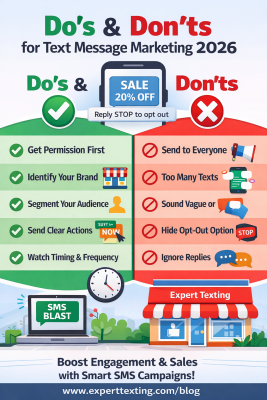
Do’s of Text message marketing for engagement and sales
1. Do get clear permission before sending
Consent is not optional. People should know what they are signing up for, what type of messages they will receive, and how often. Good opt-ins bring better engagement because the list is built from real interest, not pressure.
A strong example:
“Join our text list for weekly offers, restock alerts, and order updates.”
That works better than adding people after checkout without a clear checkbox or hiding consent in fine print.
2. Do identify your brand in every message
A text from an unknown number feels suspicious. Many SMS best-practice resources also recommend naming your business in each message so recipients know who is contacting them.
Example:
“Expert Texting: Flash sale ends tonight. Get 15% off all plans here: example.com. Reply STOP to opt out.”
This is simple, clear, and trusted.
3. Do segment before you send
Not every contact should get the same message.
Segment by:
- New subscribers
- Repeat buyers
- Recent clickers
- Inactive users
- Location
- Product interest
- Appointment status
Recent industry guidance also points toward tighter segmentation based on recent engagement windows instead of sending every campaign to the full list.
A Mass Texting Service becomes more useful when you treat it like a smart communication tool, not a megaphone.
4. Do write one clear action per text
A weak text tries to do too much. A good one gives one action.
Examples:
- Shop the sale
- Confirm your booking
- Reply YES to reserve
- Use code SAVE10 today
If you sell online, send the exact product category. If you run a service business, send the exact next step. Clear texts pull better results than clever texts.
5. Do watch timing and frequency
Timing affects response. Recent 2026 and recent-year guidance suggests midday to afternoon often performs well for clicks, while late afternoon or evening can work better for conversions. Several sources also suggest starting with roughly one to two messages a week for many programs, adjusting by season and audience behavior.
That does not mean every audience behaves the same. A restaurant lunch offer, a clinic reminder, and an ecommerce discount will not perform at the same hour.
Test small. Learn fast. Then repeat what works.
Don’ts of Text message marketing that hurt results
1. Don’t send to everyone at once
A broad SMS Blast may look efficient, but it often cuts response quality. Sending one generic message to your full list can lead to:
- Lower clicks
- More opt-outs
- More complaints
- Fewer sales
A local gym should not send the same text to trial users, current members, and expired members. Each group needs a different message.
2. Don’t over-message your subscribers
Too many texts make people leave. This is one of the fastest ways to damage your list.
Bad pattern:
Three promo texts in one day with no new value
Better pattern:
One offer, one reminder, one last-call text only if the campaign matters enough
If you use Expert Texting or any other Mass Texting Service, list health matters more than raw send volume.
3. Don’t sound vague or salesy
People ignore texts like:
“Big news coming soon”
“Check this out”
“Limited deal available now”
These lines say very little.
A better message says:
“Expert Texting: Save 20% on annual plans today only. Start here: example.com. Reply STOP to opt out.”
Specific offers beat empty hype.
4. Don’t hide the opt-out
Opt-out language should be easy to spot and easy to use. Compliance guidance across major providers consistently points to clear consent and simple opt-out handling as core rules.
If leaving your list feels hard, complaints go up.
5. Don’t ignore replies
Texting is not just broadcasting. It can also close sales.
If someone replies:
- “Do you have this in blue?”
- “Can I book for Friday?”
- “Is this package still available?”
That is a live sales chance. Two-way texting features are now a major part of modern business messaging platforms because replies often carry buying intent.
A simple 2026 formula that works
For beginners and growing businesses, this format is practical:
Brand name + offer or update + one action + opt-out
Example for ecommerce:
“Expert Texting: New arrivals are live. Shop summer deals now: example.com. Reply STOP to opt out.”
Example for services:
“Expert Texting: Your free consultation slot is open for Thursday at 3 PM. Reply YES to confirm. Reply STOP to opt out.”
Example for events:
“Doors open at 6 PM tonight. Need your ticket link again? Reply TICKET.”
This works because it is clear, fast to read, and built for action.
Final thoughts
Good Text message marketing in 2026 is not about sending more messages. It is about sending better ones.
Get permission first. Say who you are. Segment your list. Keep the message short. Give one clear action. Respect timing, Respect replies, Respect opt-outs.
That is how a business turns a simple SMS Blast into a channel that drives real engagement and real sales.
FAQs
1. How often should I send text message marketing campaigns?
For many businesses, one to two texts per week is a reasonable starting point. Then adjust based on clicks, replies, conversions, and opt-outs.
2. Is an SMS Blast still effective in 2026?
Yes, but only when the list is permission-based and the message is relevant. Generic blasts to everyone usually perform worse than segmented sends.
3. What should every text message include?
Your brand name, the main message, one clear call to action, and an easy opt-out such as “Reply STOP to opt out.”
4. Can a Mass Texting Service help increase sales?
Yes. A good Mass Texting Service helps with segmentation, scheduling, replies, tracking, and campaign control, which can lead to better engagement and stronger conversions when used properly.
About the Author

Sign up for free