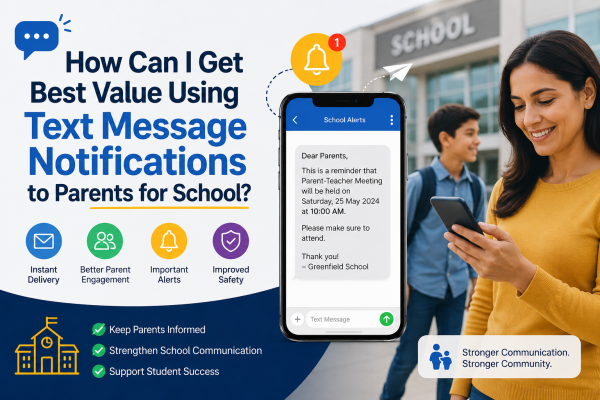
How Can I Get Best Value Using Text Message Notifications to Parents for School?
Effective communication between schools and parents plays a vital role in student success. Parents want timely updates about attendance, events, emergencies, and academic progress, while schools need a fast and reliable way to deliver important information. This is why many educational institutions are now using Text Message Notifications to Parents for School as a core communication strategy.
Unlike emails that can be overlooked or paper notices that may never reach home, text messages are delivered directly to parents’ mobile phones and are typically read within minutes. Whether it’s an attendance alert, school closure announcement, exam reminder, or emergency notification, SMS communication helps schools keep families informed and engaged.
A modern School Text Messaging System not only improves communication but also reduces administrative workload, increases parent participation, and helps schools build stronger relationships with families. In this guide, we’ll explore how schools can maximize the value of text messaging, improve parent engagement, and choose the right communication tools.
Why Schools Are Using Text Message Notifications to Parents for School
Traditional communication methods often create challenges for schools. Emails can go unread, printed notices can be lost, and phone calls require significant staff time. Text Message Notifications to Parents for School offer a faster and more efficient alternative.
Key benefits include:
- Instant delivery of important updates
- High message open rates
- Better parent engagement
- Improved attendance tracking
- Reduced administrative workload
- Lower communication costs
- Faster emergency response
Because nearly every parent carries a mobile phone, SMS remains one of the most effective communication channels available to schools today.
Email vs Text Message Notifications for Schools
When comparing communication methods, text messaging often delivers better results.
| Feature | Text Messages | |
|---|---|---|
| Open Rate | Very High | Moderate |
| Delivery Speed | Instant | Varies |
| Emergency Communication | Excellent | Limited |
| Parent Engagement | High | Medium |
| Response Time | Faster | Slower |
| Visibility | Direct to Mobile | May Go to Spam |
For urgent and time-sensitive information, SMS is generally the preferred choice.
How a School Text Messaging System Improves Communication
A reliable School Text Messaging System allows administrators, teachers, and staff to communicate with parents quickly and efficiently.
Common uses include:
- Attendance alerts
- School closure announcements
- Event reminders
- Exam schedules
- Homework notifications
- Parent-teacher meeting reminders
- Transportation updates
- Fee payment reminders
Instead of making dozens of phone calls, administrators can send one message to hundreds or thousands of parents simultaneously.
For example, if severe weather forces an early dismissal, schools can notify all parents within seconds using a single SMS broadcast.
Benefits of Using a School Communication Platform
Many schools now use a complete School Communication Platform that combines SMS, email, alerts, and reporting tools into one system.
Advantages include:
| Benefit | Impact |
|---|---|
| Faster Communication | Parents receive updates immediately |
| Better Attendance | Families stay informed about schedules |
| Emergency Readiness | Critical alerts reach parents quickly |
| Parent Engagement | Increased participation in school activities |
| Administrative Efficiency | Less time spent making phone calls |
| Improved Transparency | Better school-family relationships |
A centralized platform makes communication more organized and effective.
Getting the Most Value from Text Message Notifications to Parents for School
Send Relevant Messages
Parents appreciate information that directly affects their children. Focus on meaningful communication rather than sending excessive messages.
Examples include:
- Upcoming exams
- School holidays
- Schedule changes
- Sports events
- Attendance updates
- Fee reminders
Sending useful information consistently helps maintain engagement and trust.
Segment Your Audience
Not every message is relevant to every parent.
A quality Parent Notification System allows schools to create groups based on:
- Grade level
- Class section
- Sports teams
- Clubs
- Transportation routes
- Academic programs
Audience segmentation ensures that parents receive only the information that matters to them.
Use a Reliable Mass Texting Service
Selecting the right mass texting service is critical for successful communication.
Look for features such as:
- Group messaging
- Message scheduling
- Delivery tracking
- Contact management
- Automated notifications
- Two-way communication
- Reporting and analytics
A dependable provider ensures messages are delivered quickly and consistently.
School SMS Alerts for Daily Communication
Parents value reminders that help them stay involved in their children’s education.
Examples of effective School SMS Alerts include:
- Assembly reminders
- Examination schedules
- Bus arrival notifications
- School holiday announcements
- Event invitations
- Parent meeting reminders
These updates help parents stay informed without constantly checking emails or school websites.
Many schools report higher attendance and participation after implementing SMS communication.
Best Practices for SMS Notifications for Schools
Keep Messages Short and Clear
Parents are more likely to read concise messages.
Example:
“Reminder: Parent-teacher meeting on Friday at 3 PM in Room 205.”
Short messages improve readability and encourage faster responses.
Send Messages at Appropriate Times
Avoid sending non-emergency messages late at night.
Recommended times include:
- Morning hours
- Early afternoon
- Evening before scheduled events
Well-timed communication improves engagement and reduces frustration.
Personalize Messages
Personalized communication often generates better responses.
Example:
“Hello Sarah, Emily’s science exhibition will take place on Thursday at 10 AM.”
Personalization helps parents feel more connected to school activities.
Text Messaging for Schools During Emergencies
Safety remains one of the most important reasons schools invest in SMS communication.
Text Messaging for Schools enables administrators to send urgent updates immediately when situations arise.
Examples include:
- Severe weather closures
- Security incidents
- Transportation delays
- Medical emergencies
- Unexpected schedule changes
Unlike emails, text messages are delivered directly to mobile devices, helping parents respond quickly when needed.
School Emergency Notifications Improve Safety
Parents expect timely communication during emergencies.
Effective School Emergency Notifications should include:
- Clear instructions
- Accurate information
- Emergency contact details
- Expected timelines
- Follow-up updates
Example:
“Due to severe weather conditions, school will close at 1 PM today. Buses will depart early. Please monitor further updates.”
Providing clear information reduces confusion and reassures families.
How a Parent Alert System Supports Parent Engagement
A modern Parent Alert System helps schools maintain regular communication throughout the academic year.
Schools commonly use a Parent Alert System for:
- Attendance alerts
- Academic reminders
- Exam schedules
- Holiday announcements
- Event invitations
- Fee due date reminders
When parents receive timely information, they are more likely to stay involved and support student success.
Real-World Example
A private school with approximately 1,200 students struggled with low attendance at parent meetings and delayed communication.
After implementing a School Text Messaging System and partnering with a reliable mass texting service, the school began sending automated reminders and notifications.
Within six months:
- Parent meeting attendance increased by 42%
- Missed announcements decreased significantly
- Administrative staff saved several hours weekly
- Emergency communication became faster and more effective
The school improved both operational efficiency and parent engagement through SMS communication.
How to Choose the Right School Text Messaging System
When evaluating providers, schools should consider:
- Ease of use
- Message delivery speed
- Scheduling capabilities
- Contact management features
- Reporting and analytics
- Data security
- Customer support
- Compliance with privacy regulations
- Integration with school management systems
Choosing the right solution helps schools maximize the benefits of Text Message Notifications to Parents for School while maintaining trust and reliability.
Conclusion
Schools need communication tools that are fast, reliable, and easy for parents to use. Text Message Notifications to Parents for School provide an efficient way to share important information, improve parent engagement, and support student success.
By implementing a dependable School Text Messaging System, using targeted SMS Notifications for Schools, and maintaining an effective Parent Notification System, schools can strengthen relationships with families while ensuring critical information reaches parents when it matters most.
As educational institutions continue to embrace digital communication, SMS remains one of the most effective ways to keep parents informed, engaged, and connected to their children’s learning experience.
Frequently Asked Questions
1. Why are text messages effective for school communication?
Text messages have exceptionally high open rates and are usually read within minutes, making them ideal for both urgent and routine school updates.
2. What are School SMS Alerts used for?
School SMS Alerts are commonly used for attendance notifications, event reminders, exam schedules, weather closures, and transportation updates.
3. Can schools send emergency messages through SMS?
Yes. School Emergency Notifications allow schools to quickly inform parents about closures, delays, security incidents, and other urgent situations.
4. How does a Parent Alert System benefit schools?
A Parent Alert System improves communication efficiency, increases parent involvement, reduces missed announcements, and supports student success.
5. What features should a School Text Messaging System include?
The best systems offer group messaging, scheduling tools, delivery reports, contact management, analytics, and two-way communication capabilities.
6. Why should schools use a mass texting service?
A mass texting service enables schools to communicate with large groups instantly, save administrative time, improve message delivery, and enhance overall parent engagement.
About the Author

Sign up for free